
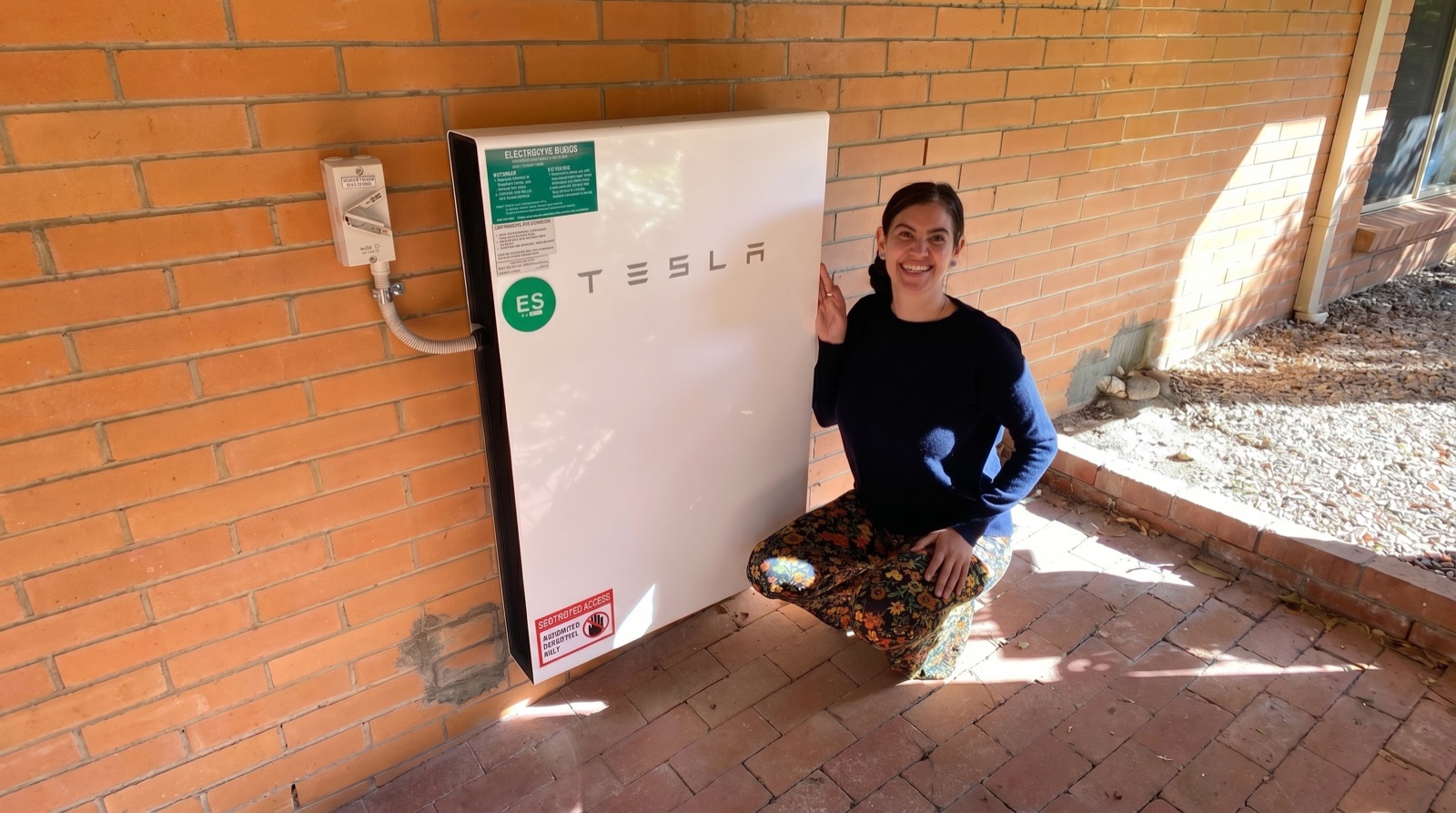
Tesla's Powerwall 3 is the most-searched home battery in Australia, and also one of the most confusingly priced. The number Tesla advertises is the hardware. The number you pay is the install.
This review uses current Australian installer pricing, not overseas figures, and separates what is verified from what is not.
At a glance
Quick answer: a Tesla Powerwall 3 in Australia costs roughly $14,000 to $16,000 fully installed in 2026, before rebates, with complex installs reaching about $17,000. After the federal Cheaper Home Batteries discount that lands around $11,400 to $13,600. You get 13.5 kWh usable, an integrated inverter (so no separate hybrid inverter for a standard single-battery install) and a 10-year warranty. Advertised prices near $11,000 to $12,000 are hardware only.
What a Powerwall 3 costs installed in Australia
The gap between the advertised price and the invoice is where most confusion starts. Tesla's listed hardware price sits near $11,900 for the battery, plus about $1,700 for the Backup Gateway. That is equipment only.
Once you add the installer, switchboard work, compliance and site specifics, Australian installers quote roughly $14,000 to $16,000 fully installed, with harder sites and regional jobs pushing toward $17,000. Independent 2026 guides put the average installed figure near $13,600, which works out to about $1,000 per usable kWh.
The federal Cheaper Home Batteries discount is applied by your installer at the point of sale, so you see it as a lower invoice rather than a cheque. On a 13.5 kWh battery it brings a typical Powerwall 3 install down to roughly $11,400 to $13,600.
The specs that actually matter
The integrated inverter is the meaningful change from Powerwall 2. For a standard single-battery install you are not buying a separate hybrid inverter, which simplifies the system and usually the install cost.
Is a Powerwall 3 worth it?
It stacks up best if you use a lot of power after dark, want genuine whole-home backup, and your feed-in tariff is low enough that storing your solar beats selling it. In most states exports now pay single-digit cents, which is what makes storage worth considering at all.
It stacks up worst if your evenings are quiet, your roof is small, or your budget would be better spent adding panels first. Panels still have the shorter payback almost everywhere in Australia.
Powerwall 3 is not the cheapest battery per kWh in Australia. Brands like Sigenergy and Sungrow compete hard on price. What Tesla sells is the integrated system, the app and the support network, and plenty of buyers pay for that deliberately.
See what a battery actually costs on your roof, with your rebate and payback figures.
30 secs · Free · No obligationFrequently asked questions

Steve Hill
Steve Hill is a renewable-energy executive with a deep background in Australian solar and energy efficiency, spanning consulting, project management and business development. He founded Elite Smart Energy Solutions, a Clean Energy Council Approved Retailer focused on smarter, lower-cost energy for homes and businesses. Steve contributes to Energy Matters, one of Australia's longest-running solar publications, and has appeared on its Road to Zero podcast. He helps Australian homeowners cut through the noise on rebates, batteries and going solar.