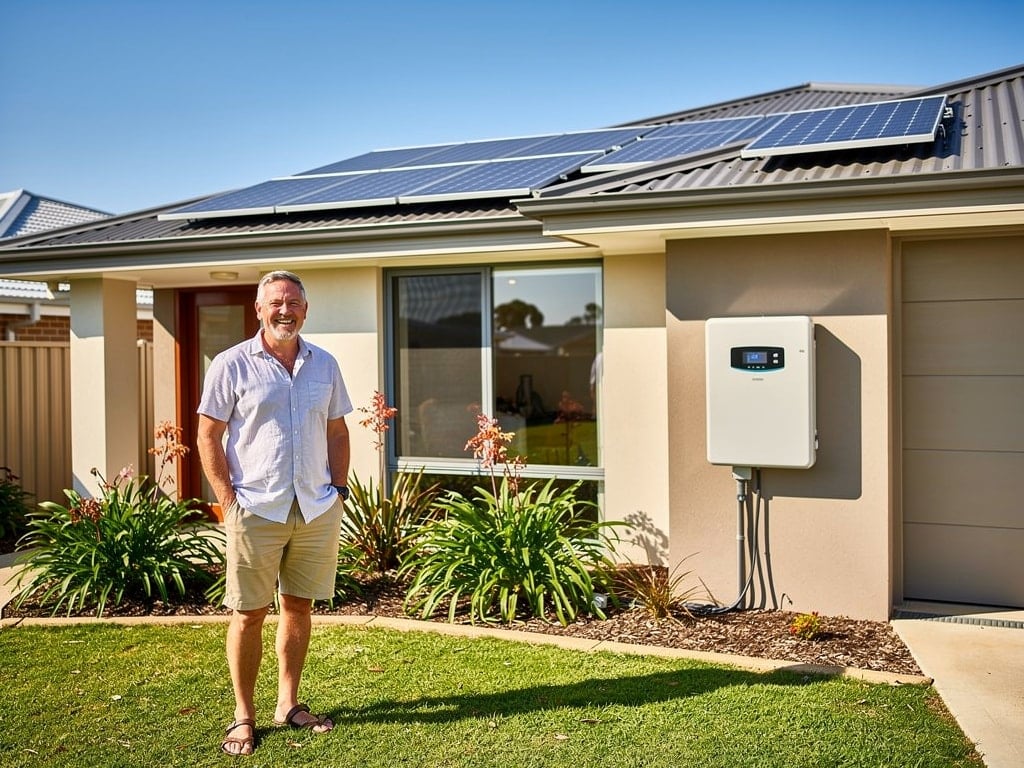

Your solar panels work hard all day. Then the sun sets, your house switches to the grid, and you buy back power at the worst price of the day, right through the evening peak. You paid for the panels, and the grid still bills you every night.
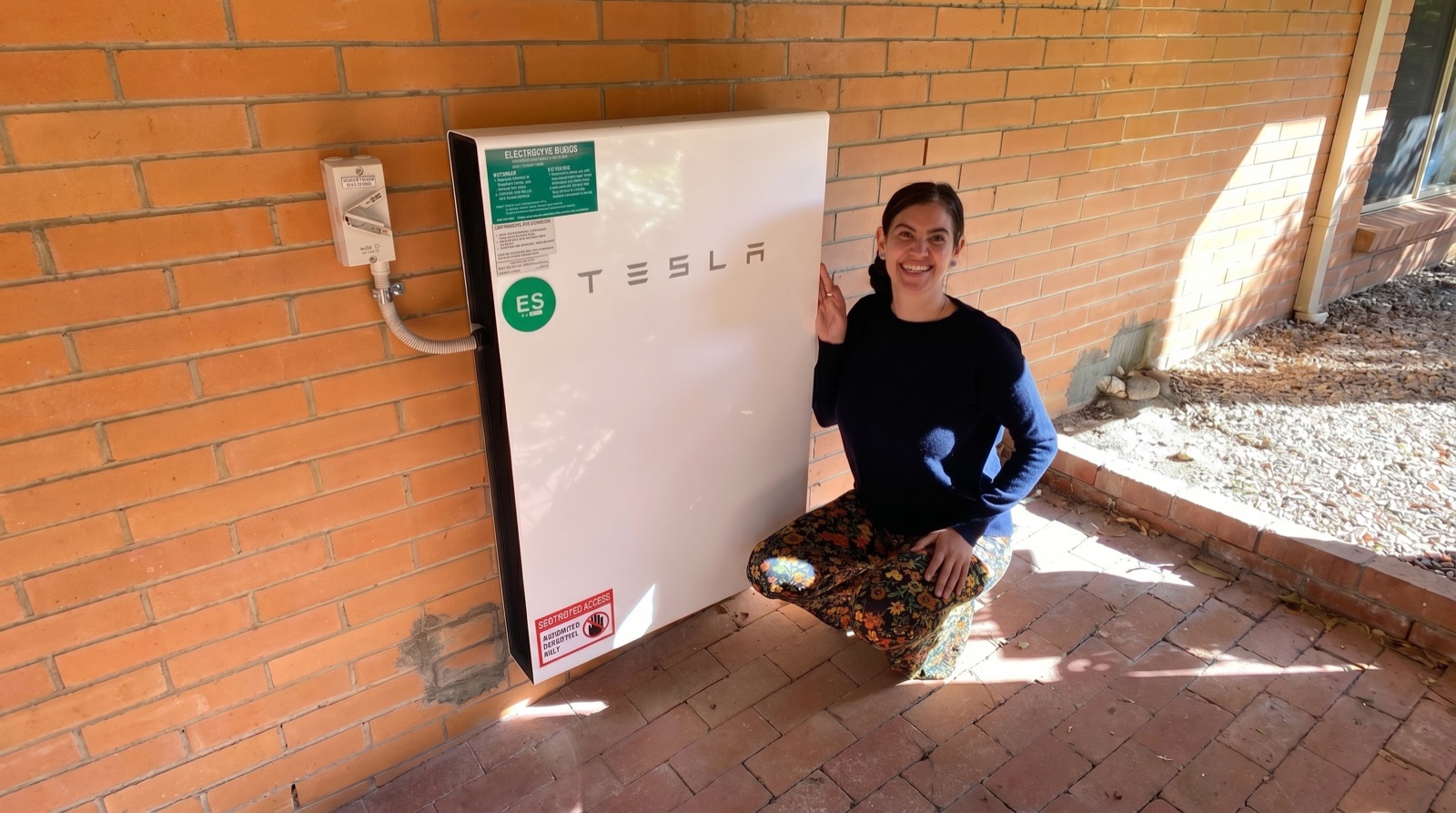
A battery fixes that. It stores your own cheap daytime solar and runs the house off it after dark, so you stop buying back power at peak rates. The thing that used to stop people was the upfront cost.
The federal Cheaper Home Batteries Program changed that in 2025. It takes around 30% off an installed battery in every Australian postcode, with no means test. In NSW, WA and the ACT a state scheme stacks on top, and some homes get to $0 upfront.
Two things to know. The rebate steps down every 6 months, so the amount you can claim is the highest it will be today. And what you can stack depends on your state. Here is what your home can claim in 2026, and how to see your number in 30 seconds.
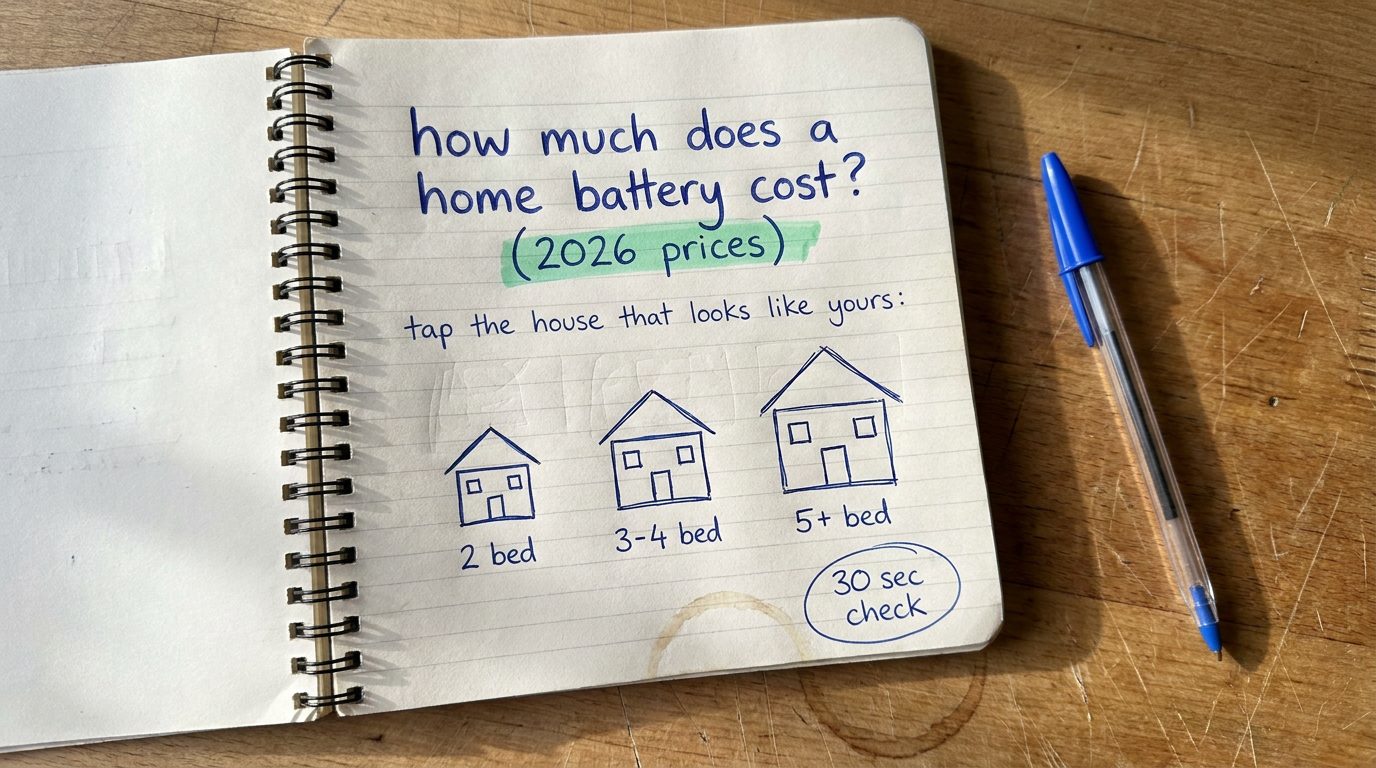
Check your battery price by size
Pick your home size and the check returns your after-rebate battery price for your postcode. It reads the live federal rebate plus any state top-up you qualify for, so the number is current today.
At a glance
3 things that changed on 1 May
The federal Cheaper Home Batteries Program reset on 1 May 2026. Three things shifted. One helps you, one costs you, one depends on the battery size you fit.
1. Most homes still get the full rate. If your battery's usable capacity is 14 kWh or under, you get the full federal rebate on every kWh. That covers most households. A 10 to 13.5 kWh battery runs a typical family's evening and overnight load off stored solar, so you only size up if you charge an EV at home, run a pool pump, or use more than 25 kWh a day.
2. The step-downs are now every 6 months. The 1 May reset cut the STC factor from 8.4 to 6.8, around 19% less rebate per kWh, and that drop is baked in. The next cut lands on 1 January 2027, then every 6 months until the program ends on 31 December 2030. Each step is locked in. Once a date passes, that rebate amount is gone.
3. Bigger batteries get less on the extra capacity. The first 14 kWh of any battery still gets the full rate. Capacity in the 14 to 28 kWh band is subsidised at around 60% of the rate, and the 28 to 50 kWh band at around 15%. So a 20 kWh battery gets the full rebate on its first 14 kWh plus a reduced rebate on the last 6 kWh. EV homes, pool homes, large families and VPP households feel this most. The check returns the exact stacked amount for your size and postcode.
The federal STC factor by period (the whole step-down schedule). The rebate is worked out as a number of small-scale technology certificates (STCs) per usable kWh, and that per-kWh factor is legislated to fall on a fixed timetable until the program ends. This is the schedule the Clean Energy Regulator applies to the first 14 kWh of usable capacity:
Each figure is locked in on its date. Because the certificate price floats (recently around $38 to $40 each), the same battery earns a smaller dollar rebate after every step. Multiply the factor by your usable kWh (first 14 kWh at 100%) and by the certificate price to get the discount.
What that works out to in dollars, by battery size. Approximate federal discount at the current (1 May – 31 Dec 2026) rate, applied at the invoice. Your exact number depends on the certificate price on the day and your battery's usable capacity — the 30-second check returns the live figure.
Figures are indicative and rounded, at a certificate price near the recent market range; they are not a quote. The 14–28 kWh portion is subsidised at ~60% and the 28–50 kWh portion at ~15%, which is why the per-kWh value tapers on the larger sizes above.
See your exact rebate for any battery size from 5 to 50 kWh.
30 secs · Free · No obligation$0 upfront: how the numbers work
Plenty of households can install a battery for $0 upfront in 2026. Three levers do the work.
1. The federal rebate comes off the invoice at install, so the cash quote starts well below the gross hardware cost. You do not claim it back. It is a discount on the price you pay.
2. State finance covers the rest where it is on offer. NSW has a new interest-free loan up to $15,000, the ACT has a low-interest loan up to $20,000, and WA has an interest-free loan up to $10,000. That spreads the post-rebate balance over the years instead of asking for it upfront.
3. Bill savings from running the house off stored solar typically run $730 to $1,680 a year. Those savings cover most or all of a monthly loan repayment, so your out-of-pocket cost stays close to zero.
Over the life of the battery, most families save $30,000 or more on power compared with staying fully grid-tied. Once the system pays off, usually 6 to 8 years in, the power you store and use is effectively free for the rest of the warranty.
See whether your home can install for $0 upfront.
30 secs · Free · No obligationStack the federal rebate with your state scheme
The federal rebate applies in every postcode. On top of it, three places run a live state scheme in 2026. The rest are federal only, because their old state schemes have closed.
NSW. The NSW Home Energy Saver, a $557 million package launched on 17 June 2026, is the headline. It pairs an interest-free loan up to $15,000 (for homes with income under $210,000, repaid over 10 years) with a targeted discount up to $4,000 for homes under $80,000 income or holding a concession card, opening later in 2026. Both stack on the federal rebate, so eligible NSW homes get to $0 upfront. The old PDRS install incentive has closed, though some retailers still offer a VPP sign-up bonus.
WA. The state Residential Battery Scheme adds up to around $1,300 for Synergy customers or around $3,800 for Horizon Power customers on top of the federal rebate. WA also runs an interest-free loan up to $10,000 (income under $210,000) for the balance. The allocation is capped and running down, so timing matters.
ACT. The Sustainable Household Scheme offers a loan up to $15,000, rising to $20,000 on 1 July 2026, repaid over 10 years. It moved to 3% interest on 1 July 2025, so it is low-interest rather than interest-free now, and there is no income test. Batteries are eligible, and it stacks on the federal rebate.
SA, VIC, QLD, TAS, NT. Federal rebate only. SA's Home Battery Scheme closed in 2022. The Solar Victoria battery loan closed in May 2025. Queensland's Battery Booster closed in May 2024, over a year before the federal program launched. Tasmania's Energy Saver Loan closed in September 2025. The NT Home and Business Battery Scheme is fully allocated and closed, with the federal rebate available where your network qualifies.
See exactly which federal and state rebates stack on your postcode.
30 secs · Free · No obligationBackup power when the grid drops
Most solar owners learn this the hard way. Solar panels alone do not run your home in a blackout. By Australian safety standard, a grid-tied system shuts off when the grid goes down, so it cannot back-feed the lines and put the repair crew at risk.
A battery with backup-mode wiring gets around that. When the grid drops, the battery isolates your home and keeps essential circuits running. Most modern batteries support this when they are wired for it at install.
Worth specifying upfront. Backup wiring is a small extra at install time and expensive to retrofit later. Tell your installer which circuits you want covered, usually the fridge, lights, internet and one power point per room. A 13.5 kWh battery keeps a typical household's essentials running for 12 to 24 hours, longer if the panels are still generating through the day.
Why waiting costs you
The rebate steps down every 6 months now, and the next cut lands on 1 January 2027. Waiting does not get you a better deal. It gets you a smaller rebate and another summer of full-price power bills.
Whatever rate you lock in for your install before a step-down date is the rate you keep. After the date, it is gone. Metro install lead times run 4 to 8 weeks, longer in regional areas, so a signed contract by early November 2026 locks in today's rate.
The WA state allocation and any capped state offers are first come, first served and running down. The 30-second check confirms the exact federal and state stack you qualify for, then matches you with an accredited installer in your postcode.
Check your rebate before the next step-down.
30 secs · Free · No obligationFrequently asked questions

Joe White
Joe has over five years of experience in the renewable energy sector. Based in Australia, he is dedicated to advancing sustainable energy solutions to benefit both the environment and local communities. In his spare time, Joe loves to surf and take his dog, Mitchy, on road trips to explore the road less traveled.