
Most battery articles won't give you a number. They'll tell you it depends. It does depend, but you can still get close in about 10 seconds, and that's what this page is for.
Here's the short version. A 10 kWh battery, the size that suits most family homes, lists at around $12,000 installed. The federal rebate takes up to around $2,700 off that at the invoice, not months later as a cheque. So you're at roughly $9,300 before your state adds anything on top.
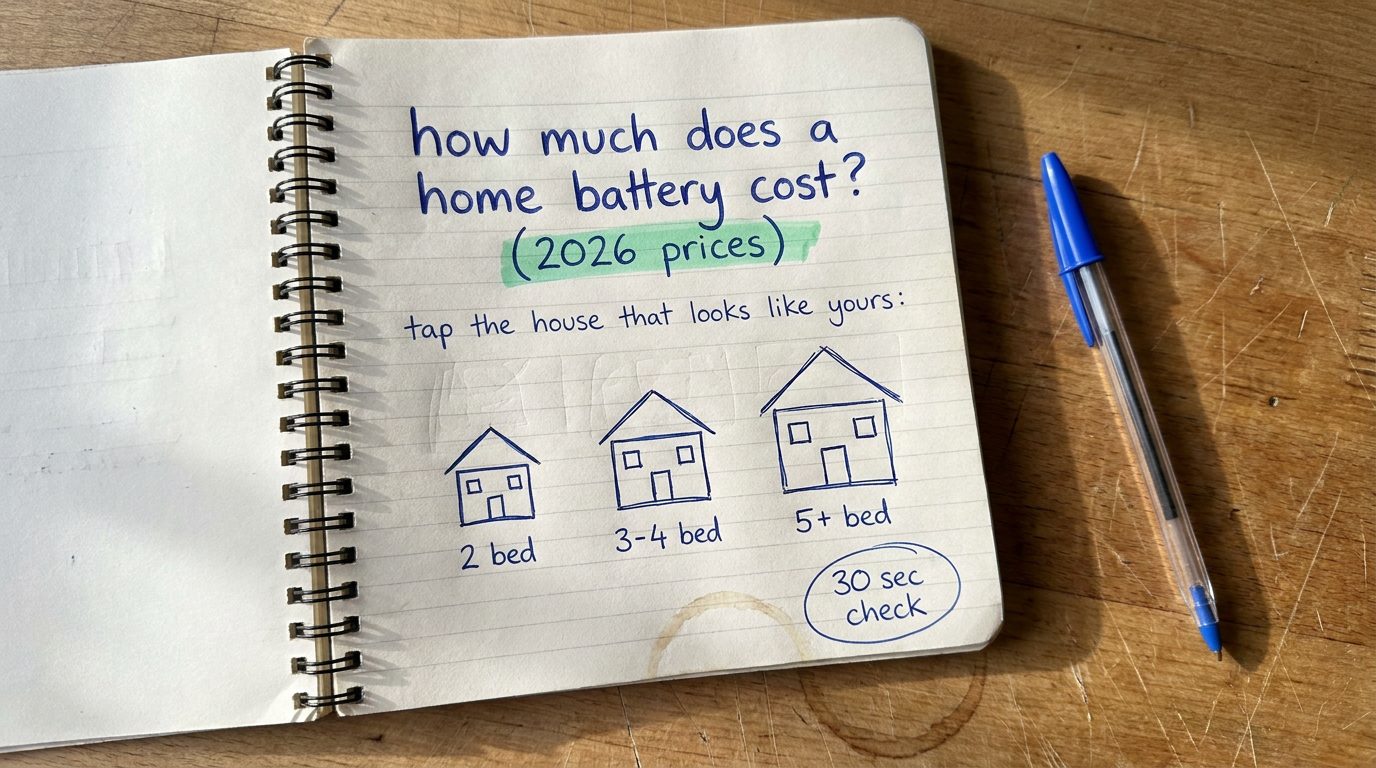
Bigger house, bigger battery, bigger rebate. Smaller house, smaller everything. Pick the house that looks like yours and you'll get the real number for your postcode.
Check your price by home size
2026 battery prices by size
Tap the house that looks like yours
It's the fastest way to a real number. 30 seconds, free, no obligation.
These are installed prices, so the battery, the inverter work and the labour are all in. The rebate column is the federal Cheaper Home Batteries amount, which comes off the invoice at install.
Two things to know about that table. The rebate is tied to your battery's usable size, not the number on the box, and prices move with the certificate market. So treat these as the shape of it, and get your own number from the check.
If you're in NSW, WA or the ACT there's more coming off on top. That's further down.
See the price for a home your size
30 secs · Free · No obligationWhy the price moved in 2026
Batteries didn't suddenly get cheap to build. The government started paying for a chunk of yours.
The federal Cheaper Home Batteries Program pays about $271 per kWh on the first 14 kWh of usable storage. It runs in every postcode. There's no income test. Your installer claims it and it comes straight off what you pay.
That's the whole reason the maths changed. A battery that would have cost you $12,000 in 2024 costs you closer to $9,300 now, for the same box on the same wall.
What actually changes your quote
Two homes on the same street get different numbers for the same battery. Here's what does that.
Usable size. A 10 kWh battery might only give you 9.5 kWh you can actually take out. The rebate follows the usable figure, so the spec sheet matters.
Your switchboard. Older boards sometimes need an upgrade before a battery can go in. Budget $800 to $2,000 if yours hasn't been touched in 20 years.
Backup wiring. Wanting the lights and fridge to stay on in a blackout is a separate bit of work. It's usually $1,000 to $2,500 on top, and plenty of people skip it.
Single or three phase. Three phase homes need a battery that can handle it, which narrows the list and lifts the price a little.
Brand. The spread between a budget battery and a premium one on the same capacity is real, and so is the difference in warranty. Cheapest is not automatically the answer here.
What your state adds on top
Most states fold everything into the federal rebate now. Three still stack something on top.
NSW. A VPP connection bonus worth up to around $1,500 for joining a Virtual Power Plant, plus the Home Energy Saver loan of up to $15,000 interest free for the rest. That's how a lot of NSW homes go in for nothing upfront.
WA. The Residential Battery Scheme adds up to around $1,300 for Synergy customers or around $3,800 for Horizon Power customers. Stacked with the federal rebate that's up to around $7,500 off. The pool is capped and running down, so WA is the one state where timing really does cost you money.
ACT. The Sustainable Household Scheme lends up to $15,000 at 3%, rising to $20,000 on 1 July 2026.
SA, VIC, QLD, TAS and NT. Federal only. QLD's Battery Booster closed in May 2024 and SA's home battery scheme closed years back, so if you see either advertised as live, it's out of date.
See what stacks in your postcode
30 secs · Free · No obligationIs it worth it?
Depends on one thing more than any other: how much power you use after dark.
If you're out all day and the house wakes up at 6pm, a battery is doing its best work. You're storing solar you'd otherwise export for a few cents and buying it back at peak rates. That gap is the whole business case.
If someone's home all day running the aircon off the panels, you're already using your solar and a battery has less to save.
For a typical family home, first year savings run about $1,000 to $1,600, more if the battery is in a VPP earning on peak dispatch. On a $9,300 net cost that's roughly a 6 to 8 year payback, then free stored power for the rest of the battery's life.
I'd be honest about the flip side. If you're moving house in 3 years, the payback maths doesn't get a chance to finish.
Why waiting costs you
The rebate steps down on 1 January 2027. On a 10 kWh battery that's roughly $550 less coming off, for the same battery, on the same wall.
Nothing else about waiting helps you either. Install lead times run 4 to 8 weeks and longer in regional areas, so a contract signed by early November holds today's rate.
Plenty of homes go in for $0 upfront through accredited installers, with the repayments covered by what you stop paying the grid. The check tells you whether that's on the table for your postcode.
Check your price before the January step-down
30 secs · Free · No obligationFrequently asked questions

Steve Hill
Steve Hill is a renewable-energy executive with a deep background in Australian solar and energy efficiency, spanning consulting, project management and business development. He founded Elite Smart Energy Solutions, a Clean Energy Council Approved Retailer focused on smarter, lower-cost energy for homes and businesses. Steve contributes to Energy Matters, one of Australia's longest-running solar publications, and has appeared on its Road to Zero podcast. He helps Australian homeowners cut through the noise on rebates, batteries and going solar.